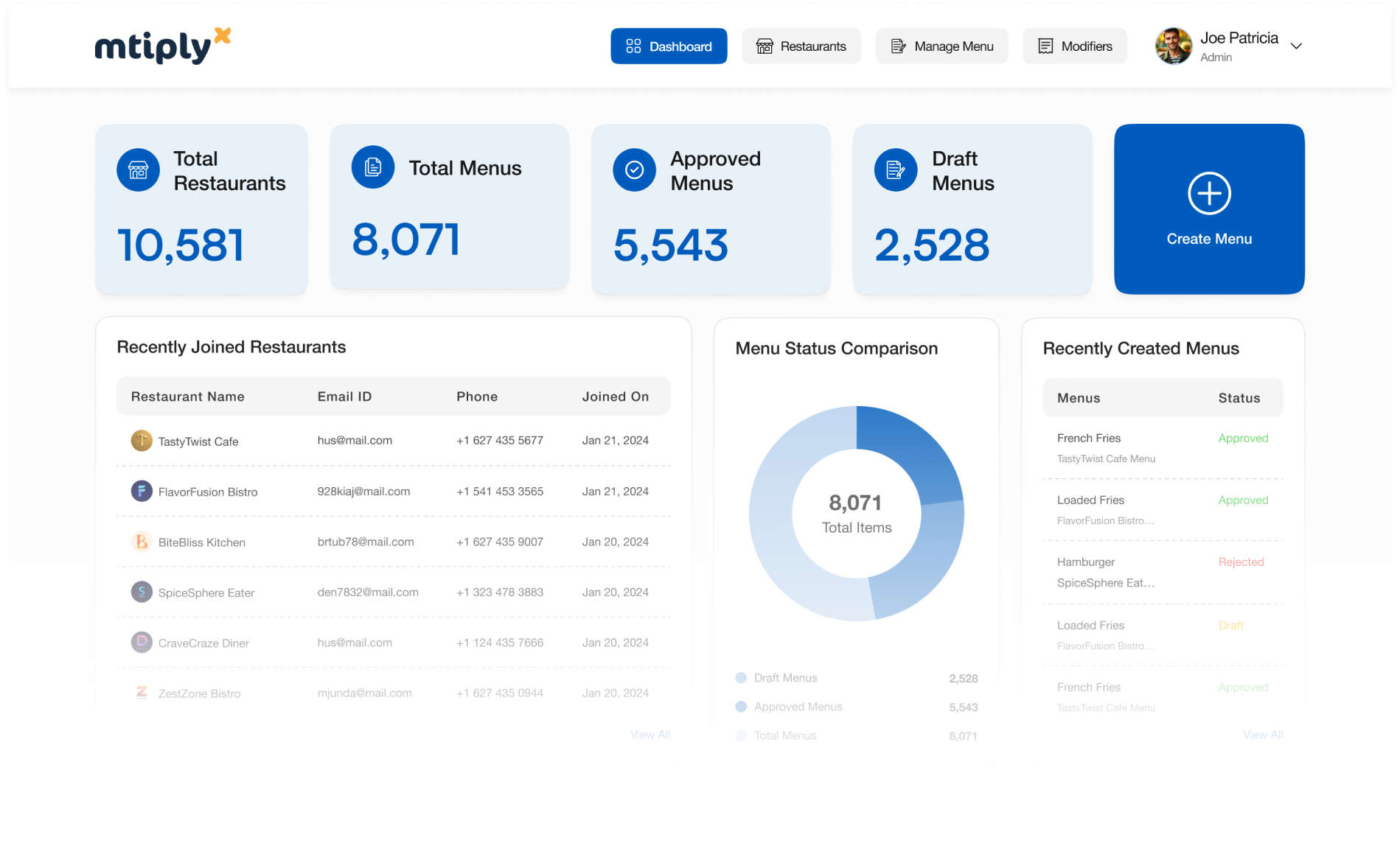
Learn about the AI –powered approach developed by our skilled team, to streamline menu management, thereby reducing the time spent on updates and guaranteeing seamless synchronization across different platforms.
BA | DEVELOPERS | DESIGNERS | QA
Founder & Owner
INDUSTRY : FOOD & BEVERAGES
DESIGN TO DEVELOPMENT
Time required to update menus was reduced by 80%.
With real-time synchronization, order errors were reduced by 90%.
Improvement in order processing speed by 70%.
01/05
While the development of the application, the team faced the below mentioned challenges:
Making sure that changes to the menu show up instantly, on all platforms like websites, apps and delivery services can be quite complicated.
Connecting the system with food delivery apps, point of sale (POS) systems and internal tools need handling of APIs and compatibility checks.
Developing a system that can effectively manage a number of menus, items and customization choices as the business grows, is essential.
Crafting an interface that's easy to use for kitchen staff, and administrators with varying levels of know-how is crucial.
Managing and updating databases containing menu items, prices and nutritional details while ensuring data accuracy poses a hurdle.
Tailoring the system for regions, languages and currencies to support operations demands, meticulous planning and execution.
02/05
Here are the methods by which the team overcame the above-mentioned challenges:
To ensure synchronization across all platforms, consider using an event driven architecture with technologies like WebSockets or real time databases such as Firebase.
Develop an API management layer to standardize communication with different platforms. Use middleware to manage API protocols, formats and authentication methods for integration with POS systems, delivery apps and internal tools.
Design the system using a microservices architecture to allow individual components like menu management and order processing to scale independently.
Conduct user research to understand the needs of kitchen staff and administrators. Create a responsive interface based on their feedback.
Utilize robust data management practices such as normalization, indexing and validation rules to maintain data accuracy within the system.
Incorporate localization frameworks that facilitate adaptation of the system to languages, currencies and regional preferences.
03/05
Here are some commendable results, obtained by our team of developers:
Time required to update menus was reduced by 80%.
With real-time synchronization, order errors were reduced by 90%.
Improvement in order processing speed by 70%.
System can handle more orders with performance efficiency between 85%-90%.
04/05
Here are some prominent technologies leveraged for the development of Mtiply:
Next is a React framework that allows for server-side rendering and static site generation, improving web performance and boosting SEO.
MongoDB is a NoSQL database, known for its document focused data model for managing extensive amounts of unstructured or semi structured data.
Node is an event-based JavaScript runtime, powered by Chromes V8 engine, making it possible to create effective server-side applications.
05/05
Our website require some cookies to function properly. Read our privacy policy to know more.