 Location :
Orlando, FL, USA
Location :
Orlando, FL, USA +1 (407) 714-1616
 info@biz4group.com

- The AI virtual assistant development cost typically ranges from $10,000 for basic MVP solutions to $150,000+ for enterprise-grade AI assistants, depending on complexity, integrations, scalability, and business requirements.
- Businesses can estimate the cost to develop AI Virtual Assistant solutions using a simple formula: (Development Hours × Development Rate) + Data Preparation + Integrations + Testing + Maintenance
- A complete AI virtual assistant development cost breakdown includes planning, design, development, testing, deployment, infrastructure setup, and long-term maintenance expenses.
- The cost of creating an AI virtual assistant for business often increases due to hidden expenses like infrastructure, compliance, security audits, API licensing, model retraining, and integrations, which can add 20% to 40% more costs if not planned properly.
- Businesses can optimize the custom AI virtual assistant development cost through MVP launches, pre-built frameworks, phased rollouts, cloud optimization, and strategic outsourcing.
- The cost to make a virtual assistant using AI becomes significantly easier to justify when organizations monetize through customer support automation, sales workflows, operational efficiency, analytics, and white-label opportunities.
- For modern enterprises, AI virtual assistant development cost for businesses should be viewed as an investment strategy focused on automation, scalability, customer experience, and measurable ROI.
- Biz4Group helps businesses reduce development risks by delivering cost-optimized, scalable, and customized AI virtual solutions designed to maximize ROI while accelerating time-to-market.
How much does it cost to build an AI virtual assistant, and why do quotes from vendors vary from $10,000 to well over $150,000?
If you're evaluating AI virtual assistant development vendors and comparing pricing, features, scalability, and long-term ROI, this is probably the first question you're trying to answer.
The reality is simple: the cost to develop AI Virtual Assistant solutions depends heavily on business goals, integrations, complexity, data requirements, deployment channels, and customization needs. A basic assistant that handles FAQs and appointment booking costs significantly less than a multilingual AI system capable of automation, analytics, sales support, and workflow execution.
This is exactly why understanding AI virtual assistant development cost has become a strategic business decision rather than simply a technical one.
Businesses are rapidly moving from AI experimentation toward large scale deployment, with enterprise AI adoption accelerating across industries as organizations focus on operational efficiency and automation. Enterprise adoption is shifting from pilot projects to production scale implementations, creating stronger demand for custom AI assistants and workflow automation.
Recent industry research by Nvidia also shows organizations increasingly prioritize AI investments because intelligent automation can significantly improve productivity, customer support efficiency, and operational scalability.
In this guide, you'll learn how much does it cost to build AI virtual assistant solutions, understand custom AI virtual assistant development cost drivers, compare pricing models across vendors, and learn how to estimate cost of building custom AI virtual assistant for business use without overspending.
For most businesses, the average cost to create AI virtual assistant solutions typically ranges between $10,000 to $150,000+, depending on scope, complexity, and enterprise requirements.
Why Consider the Cost of Building an AI Virtual Assistant Before You Dive In?
Many businesses want to launch an AI assistant quickly, but one major problem slows them down: they want to budget properly for AI virtual assistant development but lack clarity on cost drivers and ranges.
That uncertainty often leads to overspending, delayed launches, poor feature planning, or choosing the wrong development partner.
Understanding the development pricing of AI virtual assistant solutions before starting helps businesses make smarter technical and financial decisions. Whether you're planning a support bot, workflow automation system, or enterprise-grade assistant, knowing the expected investment early prevents expensive surprises later.
The reality is that the AI-powered virtual assistant software cost can vary significantly based on features, integrations, scalability, AI model complexity, deployment platforms, and security requirements. A basic MVP may start around $10,000, while advanced enterprise assistants with multilingual support, analytics, voice AI, and automation workflows can exceed $150,000+.
Businesses that evaluate costs early usually benefit in three major ways:
1. Better Budget Planning
Clear pricing expectations help companies align business goals with realistic development scope. This reduces scope creep, unexpected API costs, and expensive mid-project feature changes.
2. Higher ROI Visibility
Companies investing in customer service AI chatbot solutions often reduce operational costs while improving customer response times and workflow efficiency. Understanding the full cost structure helps decision-makers estimate long-term ROI more accurately.
3. Smarter Vendor Evaluation
When comparing vendors, businesses need visibility into:
- Development timelines
- AI infrastructure costs
- Integration pricing
- Maintenance expenses
- Scaling costs
- Support and optimization fees
This is especially important when selecting an experienced AI development company that can balance innovation, scalability, and budget efficiency.
The good news is that modern intelligent virtual assistant development services cost structures are far more flexible than most businesses assume. With the right planning approach, companies can optimize features, reduce unnecessary expenses, and build scalable AI assistants without overspending.
In the next section, we’ll break down exactly how to estimate AI virtual assistant development cost step by step, including the major cost drivers vendors often fail to explain clearly.
A Simple Formula to Calculate the Cost to Build AI Virtual Assistant
One of the biggest questions businesses ask before investing is simple: "I want to create an AI virtual assistant for customer support but need realistic cost estimation before investing."
The challenge is that pricing varies significantly depending on complexity, integrations, AI capabilities, and deployment requirements. Instead of relying on rough guesses, businesses should use a structured approach to estimate costs.
A practical way to calculate AI virtual assistant budgets is:
Total Cost = (Development Hours × Hourly Rate) + Data Preparation + Integrations + Testing + (Maintenance × Years)
This formula acts as a simple AI virtual assistant development cost estimator that helps businesses understand where their budget actually goes.
Let's look at a realistic example for a mid-sized customer support assistant.
| Cost Component | Estimate (USD) | Notes |
|---|---|---|
|
Development Hours |
800 hrs × $50 = $40,000 |
Based on a mid-level team rate |
|
Data Preparation |
$8,000 |
Cleaning, labeling, and curating training data |
|
Integrations |
$6,000 |
CRM, ERP, or communication tools |
|
Testing & QA |
$5,000 |
Ensures bug-free, reliable assistant |
|
Maintenance (3 years) |
$7,000 × 3 = $21,000 |
Regular updates, bug fixes, scaling |
|
Total Estimate |
~$80,000 |
Example for a mid-tier assistant |
Real Scenario: Customer Support AI Assistant Cost Estimation
Suppose a company wants to deploy an AI customer support assistant capable of:
- Answering FAQs
- Escalating support tickets
- Connecting with CRM systems
- Handling multi-channel conversations
- Supporting moderate traffic volumes
Using the formula above, a realistic investment range may fall between $40,000 to $100,000+, depending on integrations and feature complexity.
However, another major factor affects pricing: who builds the solution.
| Build Approach | Estimated Cost Range (USD) | Pros | Cons |
|---|---|---|---|
|
In-House Team |
$120,000–$200,000+ |
Full control, aligned with company culture |
Higher salaries, slower ramp-up, limited expertise |
|
Outsourcing |
$40,000–$120,000 |
Lower cost, faster time-to-market, access to diverse expertise |
Less direct control, requires partner trust |
Many businesses choose outsourcing because it often reduces the cost to develop AI virtual assistant solutions by 20% to 40% while accelerating time to market.
The goal of cost estimation is not finding a perfect number. The goal is understanding the variables driving pricing.
Once businesses account for development hours, infrastructure, integrations, testing, maintenance, and delivery approach, estimating the cost of building an AI virtual assistant becomes significantly more predictable.
Now that we understand how pricing works mathematically, let's examine the biggest factors that determine whether your project stays closer to $10,000 or moves beyond $150,000+.
Ready to Crunch Your Own AI Budget?
Stop guessing, let’s turn that formula into a real roadmap for your assistant.
Get Your Cost EstimateFactors That Influence the AI Virtual Assistant Development Cost
One of the most common concerns businesses have is this: “I want to develop a custom AI virtual assistant but need to understand what actually drives the cost and why prices vary so much.”
The confusion is understandable because two AI virtual assistants may appear similar on the surface while having completely different development requirements behind the scenes.
For example, a basic support chatbot that answers FAQs costs far less than an enterprise AI assistant capable of voice interactions, CRM integrations, workflow automation, multilingual communication, analytics, and decision-making support.
This is why the AI virtual assistant development cost is not a fixed number. It is determined by multiple technical, operational, and business factors that directly affect development complexity, infrastructure needs, scalability, security, and long-term maintenance.
Before choosing a vendor or setting a budget, businesses should understand which features increase costs, which investments improve ROI, and where development expenses can scale rapidly over time.
Here’s a quick overview of the most common pricing tiers:
| Type of AI Virtual Assistant | Estimated Cost Range (USD) | What You Get |
|---|---|---|
|
MVP / Basic Assistant |
$10,000–$40,000 |
Simple Q&A, FAQ automation, scheduling, limited integrations |
|
Advanced Assistant |
$40,000–$100,000 |
NLP, voice recognition, multi-language support, CRM integration, analytics |
|
Enterprise-Level Assistant |
$100,000–$150,000+ |
Multi-channel, sentiment analysis, decision-making, security & compliance, large-scale integrations |
The sections below break down the exact factors that influence whether your AI virtual assistant stays within a startup-friendly budget or grows into a large-scale enterprise investment.
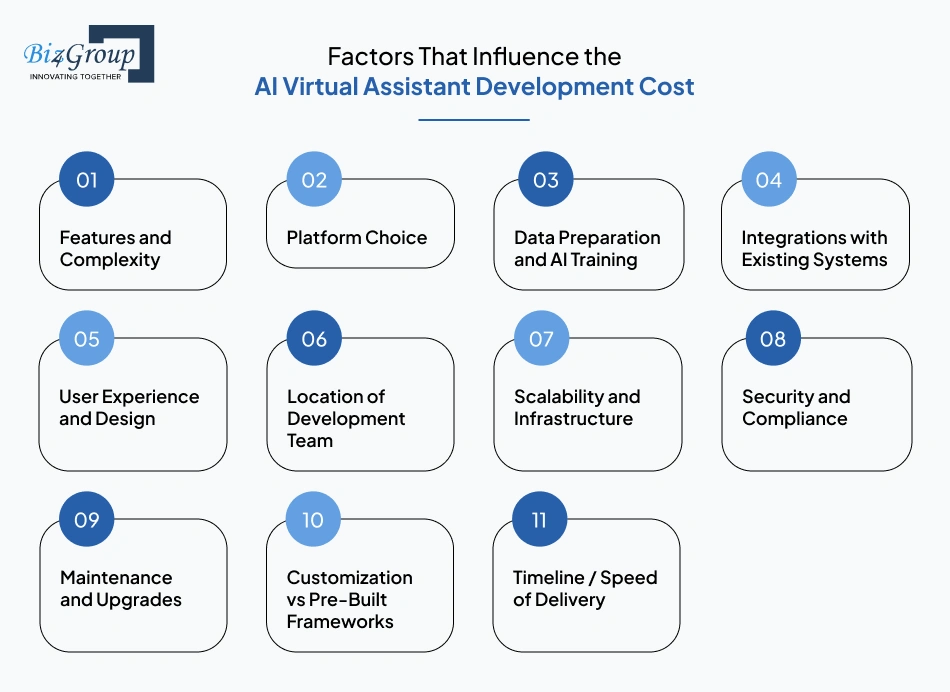
1. Features and Complexity
- Basic chatbot? $10K–$20K.
- Add voice interaction, multilingual support, or advanced memory? That’s +$5K–$20K.
- The smarter you want it, the bigger the bill.
But partnering with an experienced AI app development company ensures that added complexity translates into real business value.
2. Platform Choice
- One platform (say, web): $10K–$20K.
- Omnichannel deployment (mobile app, Slack, WhatsApp, website): +$15K–$25K.
- More channels = more convenience for your users, more cost for you.
3. Data Preparation and AI Training
- Small clean datasets: ~$5K.
- Large, messy datasets needing annotation: $20K–$40K.
- The better the data, the sharper the assistant.
4. Integrations with Existing Systems
- CRM, ERP, or HR tools each add $3K–$10K.
- Highly integrated assistants cost more, but they also pay off faster in efficiency, especially when leveraging professional AI integration services that ensure smooth connectivity across systems.
5. User Experience and Design
- Basic UI: $3K–$5K.
- Sleek, branded, multi-platform design: $10K–$15K.
- Because first impressions count, even for bots.
Pro tip: working with an experienced UI/UX design company can make all the difference in creating a smooth, engaging experience in a budget.
Also read: Top 15 UI/UX Design Companies in USA
6. Location of Development Team
- US-based teams: $80–$150/hr.
- Offshore experts (India, Eastern Europe): $25–$60/hr.
- Going global can save you up to 50 percent of costs.
7. Scalability and Infrastructure
- Cloud hosting and compute: $2K–$10K+ annually depending on traffic.
- Skimp here, and your assistant could crash when you need it most.
8. Security and Compliance
- Regulations like GDPR, HIPAA, or SOC 2 add $5K–$20K+.
- Necessary if you’re in healthcare, finance, or any sensitive-data industry.
9. Maintenance and Upgrades
- Annual updates and bug fixes: 15–25 percent of initial cost per year.
- Ignore this and your assistant will age faster than last year’s iPhone.
10. Customization vs Pre-Built Frameworks
- Using frameworks like Dialogflow or Rasa can cut costs by 20–30 percent.
- Going fully custom means flexibility, but with a higher upfront spend, and often requires the expertise of an AI agent development company to get it right.
11. Timeline / Speed of Delivery
- Need it in 6 months? Normal cost.
- Need it in 2 months? Expect 10–25 percent higher due to larger teams or rush fees.
So when you ask, what is the cost to make AI virtual assistant, the answer depends on how powerful, polished, and fast you want your digital employee to be.
Just like buying a car, you can drive home in an economical hatchback or a fully loaded luxury SUV, the choice is yours, and the price tag follows.
Industry-Specific AI Virtual Assistant Development Cost
One of the biggest mistakes businesses make when estimating AI budgets is assuming every virtual assistant costs roughly the same to build.
In reality, the cost of developing an AI virtual assistant varies significantly by industry because every sector has different compliance requirements, integrations, customer expectations, security standards, and workflow complexity.
For example:
- A healthcare AI assistant may require HIPAA compliance, EMR integrations, and secure patient data handling.
- A banking assistant needs fraud detection, identity verification, and regulatory compliance.
- An eCommerce AI assistant focuses more on personalization, recommendations, and customer engagement.
This is why industry-specific requirements play a major role in determining development timelines, infrastructure costs, AI training complexity, and long-term maintenance expenses.
Businesses evaluating vendors should also understand that pricing differences often reflect:
- Custom AI model requirements
- Industry compliance standards
- Third-party API integrations
- Scalability needs
- Data security architecture
- Omnichannel deployment complexity
Here’s a realistic breakdown of AI virtual assistant development costs across industries:
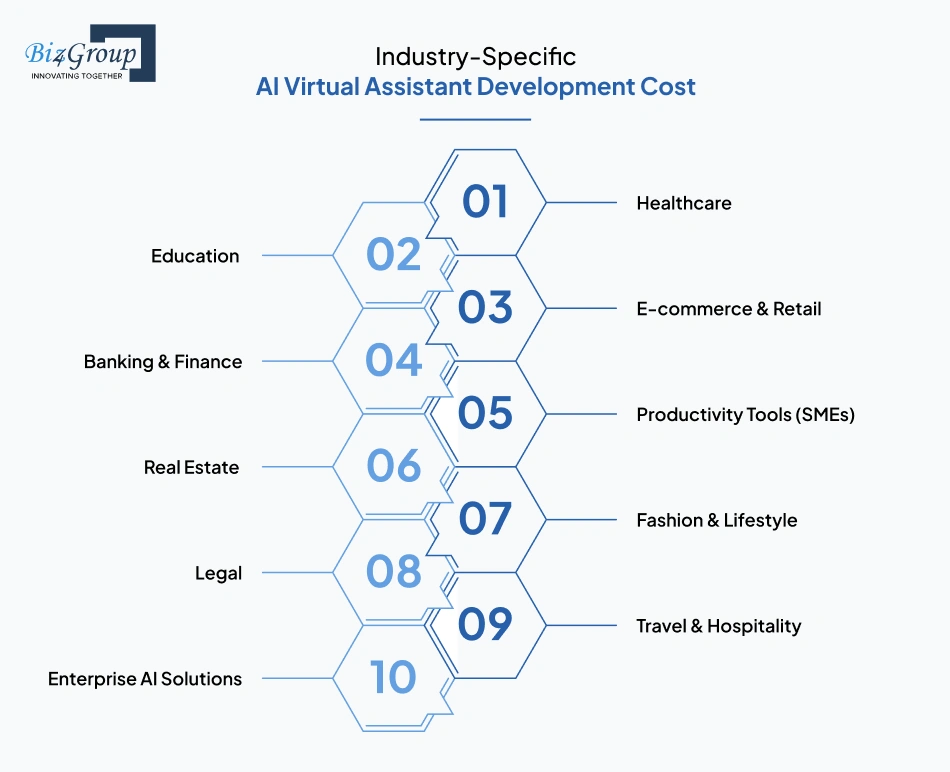
| Industry | Typical Use Case | Key Add-Ons | Average Development Cost Range |
|---|---|---|---|
|
Healthcare |
Patient scheduling, symptom checkers, insurance queries |
HIPAA compliance, EMR integration |
$80,000 – $150,000+ |
|
FAQs, grading, student support |
LMS integration, NLP for academic queries |
$50,000 – $120,000 |
|
|
Product recommendations, order tracking, returns |
Payment gateway integration, personalized upselling |
$50,000 – $120,000 |
|
|
Account management, fraud alerts, loan assistance |
High-security protocols, KYC/AML compliance |
$100,000 – $200,000+ |
|
|
Task automation, reminders, team collaboration |
Calendar sync, workflow automation |
$10,000 – $50,000 (MVP to advanced) |
|
|
Property listings, lead nurturing, mortgage FAQs |
MLS integrations, virtual tours |
$60,000 – $110,000 |
|
|
Personalized styling, outfit recommendations |
Trend analysis, AR try-on integration |
$40,000 – $90,000 |
|
|
Document drafting, compliance checks, case FAQs |
Secure document storage, multi-lingual support |
$80,000 – $150,000 |
|
|
Travel & Hospitality |
Booking support, itinerary updates, multilingual chat |
Flight/hotel API integrations, global language support |
$40,000 – $100,000 |
|
Large-scale automation, customer experience platforms, omnichannel support |
High-end integrations, scalability, custom AI models |
$120,000 – $250,000+ |
The table above highlights an important reality: AI virtual assistant pricing is heavily influenced by business domain complexity rather than just chatbot features alone.
Industries dealing with sensitive data, advanced automation, or enterprise-scale workflows naturally require larger investments due to stricter compliance, infrastructure, and scalability requirements.
For businesses comparing development vendors, understanding these industry-specific cost drivers makes it easier to:
- Set realistic budgets
- Prioritize high-impact features
- Avoid underestimating infrastructure costs
- Choose the right AI architecture
- Evaluate ROI more accurately
Whether you're planning a customer support assistant, enterprise workflow automation platform, healthcare AI solution, or multilingual commerce assistant, the final development cost always reflects the technical and operational demands of your industry.
Think Your Industry Is Too Complex for AI?
Spoiler: it’s not. From retail to healthcare, assistants are already working overtime.
Schedule a Free CallLet’s peel back the curtain and see where the money really goes, phase by phase.
AI Virtual Assistant Development Cost by Phases
Many businesses make the mistake of treating AI development as a single expense rather than a multi-stage investment. In reality, building an AI virtual assistant involves several development phases, each contributing differently to the overall budget, timeline, and long-term ROI.
If you're trying to estimate cost of building custom AI virtual assistant for business use, understanding phase-wise cost distribution is one of the most effective ways to avoid underestimating budgets and missing hidden expenses.
This becomes even more important when considering budget planning for AI virtual assistant development for SaaS and enterprise systems, where integrations, scalability, infrastructure, compliance, and maintenance can significantly affect total costs.
Think of AI development like building a product rather than purchasing software. Every stage, from research and design to deployment and ongoing optimization, requires separate investments that collectively determine the success of the project.
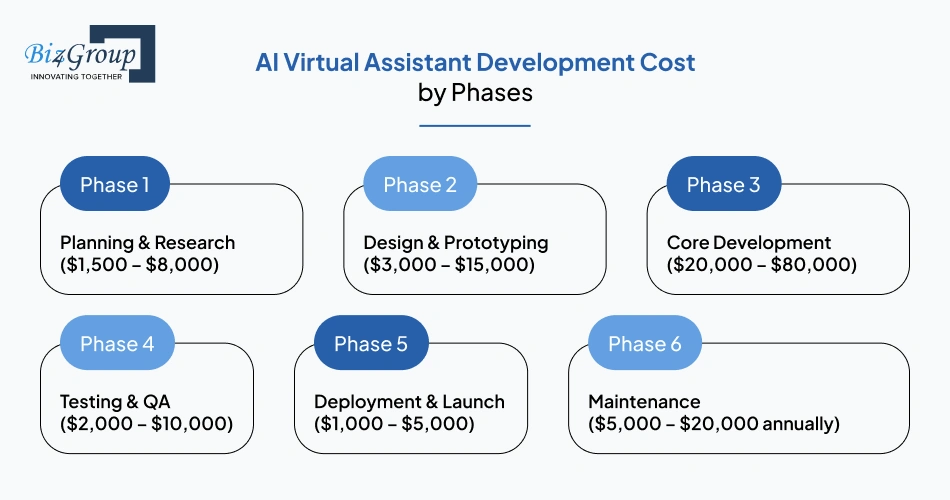
Here’s the detailed breakdown of where businesses typically spend during AI virtual assistant development:
| Development Phase | Cost Range (USD) | What’s Included | % of Total Cost |
|---|---|---|---|
|
Planning & Research |
$1,500 – $8,000 |
Market research, scope definition, choosing tech stack, competitor benchmarking |
5–10% |
|
Design & Prototyping |
$3,000 – $15,000 |
UI/UX design, conversation flows, wireframes, user journey mockups |
10–15% |
|
Core Development |
$20,000 – $80,000 |
Backend, frontend, NLP integration, APIs, training, feature development |
60–70% |
|
Testing & QA |
$2,000 – $10,000 |
Functional testing, stress testing, user acceptance testing, bug fixes |
5–10% |
|
Deployment & Launch |
$1,000 – $5,000 |
Cloud setup, security configuration, live environment support |
2–5% |
|
Maintenance (Annual) |
$5,000 – $20,000 |
Updates, bug fixes, retraining models, scaling infra, new features |
15–25% (recurring) |
Phase 1: Planning & Research ($1,500 – $8,000)
This is the blueprint stage. Skimp here, and you risk building the wrong thing.
Good planning includes market research, competitor analysis, user needs assessment, and choosing the right tech stack.
Spend a few thousand here and save tens of thousands in “do-overs” later.
Phase 2: Design & Prototyping ($3,000 – $15,000)
Users don’t just want functionality, they want flow.
Great design means mapping out conversations, building intuitive UI/UX, and creating prototypes you can actually test.
A well-designed prototype can reduce rework in development by up to 30%, saving both money and sanity.
Phase 3: Core Development ($20,000 – $80,000)
This is where most of your money goes. Core development covers frontend, backend, AI/NLP model integration, training, and all the features you promised your stakeholders, the very essence of professional AI product development services.
Complexity is the cost driver here:
- Basic assistants (FAQs, scheduling) land closer to $20K.
- Advanced assistants (voice, sentiment analysis, multilingual support) climb toward $80K+.
Plan for this phase to eat up about two-thirds of your total budget.
Phase 4: Testing & QA ($2,000 – $10,000)
Nobody likes buggy bots. Functional tests, stress tests, and user acceptance testing make sure your assistant works smoothly before the big launch.
The rule of thumb? Allocate at least 10% of your total budget here.
It’s cheaper to catch errors now than to fix them while users are already complaining.
Phase 5: Deployment & Launch ($1,000 – $5,000)
Deployment covers cloud hosting, server setup, and final security checks.
This phase is usually light on cost, but heavy on importance. A smooth launch makes the difference between early adoption and early abandonment.
Phase 6: Maintenance ($5,000 – $20,000 annually)
Here’s the part people forget to budget for. AI assistants aren’t a one-time project, they evolve.
Expect to spend 15–25 percent of your initial development cost every year on updates, bug fixes, scaling, and retraining your AI with new data.
Skip this, and your assistant will age faster than your last iPhone.
Why This Phase-Wise Cost Breakdown Matters
Understanding development costs phase by phase helps businesses move from rough estimates to realistic budgeting.
More importantly, it answers critical questions buyers often have:
- Where does most of the budget go?
- Which phases affect ROI the most?
- What costs are recurring versus one-time investments?
- How should budgets differ for startups, SaaS products, and enterprise systems?
When businesses understand how costs are distributed across planning, design, development, testing, deployment, and maintenance, budgeting becomes significantly more predictable.
The total cost to build an AI virtual assistant may range from $10,000 to $150,000+, but understanding how each phase contributes helps organizations control spending, prioritize features, and maximize long-term returns rather than simply chasing the lowest development quote.
Next, let’s talk about the sneaky line items that rarely make it into cost estimates: the hidden costs of AI virtual assistant development that can derail budgets if you’re not careful.
Which Phase Will Drain Your Wallet?
Don’t worry, we’ll help you invest smart at every stage of development.
Contact NowNext, let’s talk about the sneaky line items that rarely make it into cost estimates: the hidden costs of AI virtual assistant development that can derail budgets if you’re not careful.
Hidden Costs in AI Virtual Assistant Development Nobody Warns You About
One of the biggest reasons AI projects exceed budgets is not the initial development quote, it’s the hidden operational and scaling expenses that businesses fail to account for early.
Many companies researching pricing models for AI virtual assistant development focus only on upfront development costs while overlooking long-term infrastructure, integrations, compliance, retraining, and support expenses.
This becomes even more critical when calculating the cost of integrating AI virtual assistant into business workflows and platforms, where APIs, enterprise software connections, security layers, and ongoing optimization can quietly increase total spending over time.
The reality is that most AI development proposals highlight feature costs, but not always the hidden technical and operational expenses that appear after deployment.
Understanding these hidden costs early helps businesses:
- Build more realistic budgets
- Avoid unexpected post-launch expenses
- Compare vendors more accurately
- Estimate long-term ROI properly
- Prevent infrastructure and maintenance surprises
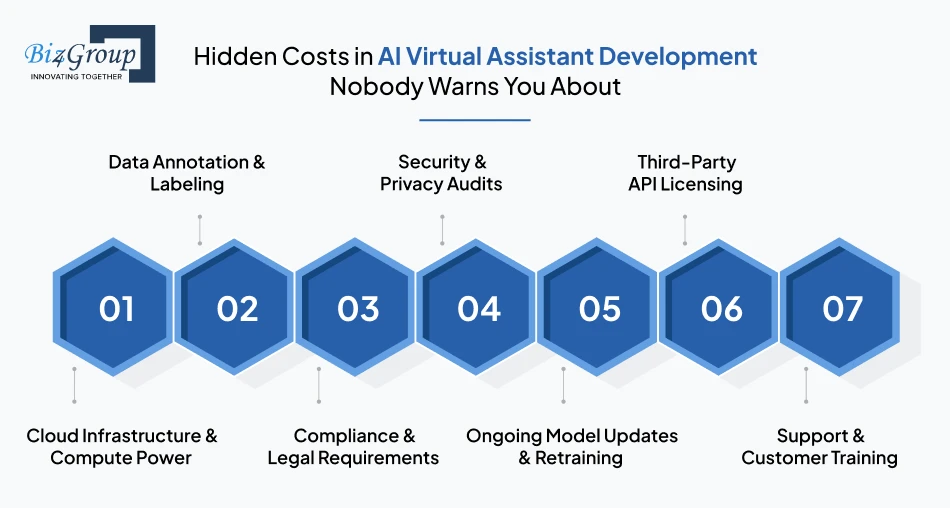
Here are the most common hidden costs businesses should plan for before starting AI virtual assistant development:
Cloud Infrastructure & Compute Power
- $1,000–$10,000+ per year depending on traffic and usage.
- Training and running models isn’t free, servers and GPUs will send you a monthly bill.
- Hidden danger: unexpected user spikes can double your costs overnight.
Data Annotation & Labeling
- $5,000–$40,000 depending on dataset size.
- Your AI is only as good as the data it learns from. Cleaning and labeling large volumes of data is labor-intensive and often overlooked in budgets.
Compliance & Legal Requirements
- $10,000–$25,000 upfront for industries like healthcare (HIPAA), finance (SOC 2), or GDPR-heavy markets.
- Necessary to avoid legal nightmares (and fines that make development costs look like pocket change).
As businesses move toward more autonomous systems, like when they build agentic AI, compliance and governance become even more critical.
Security & Privacy Audits
- $5,000–$15,000 annually.
- Ongoing audits protect you from breaches. It’s far cheaper than paying for reputation damage after a data leak.
Ongoing Model Updates & Retraining
- 15–25% of your initial development cost annually.
- AI assistants get outdated if they aren’t retrained with new data. Treat it like regular brain workouts for your digital employee, something a generative AI development company can help manage effectively with advanced retraining and fine-tuning.
Third-Party API Licensing
- $500–$5,000 per month.
- Voice services, NLP APIs, and CRM connectors all come with recurring fees. It’s the subscription economy, and your assistant isn’t exempt.
Support & Customer Training
- $2,000–$8,000 depending on team size.
- Rolling out a new AI tool often requires onboarding your staff and creating training resources.
Why These Hidden Costs Matter
Individually, these expenses may seem manageable. But combined, hidden operational costs can increase total AI virtual assistant development spending by 20% to 40% or more if businesses fail to plan properly.
This is why experienced organizations evaluate both:
- Initial development costs
- Long-term operational expenses
before selecting an AI vendor or approving budgets.
The good news is that most hidden costs can be anticipated early through proper architecture planning, scalable infrastructure decisions, realistic maintenance forecasting, and transparent vendor discussions.
Understanding these expenses upfront allows businesses to create more accurate ROI projections and avoid budget overruns after deployment.
Next, let’s explore how businesses can optimize AI virtual assistant development costs strategically without sacrificing quality, scalability, or long-term performance.
How to Optimize AI Virtual Assistant Development Cost Without Cutting Corners?
Building an AI assistant is like remodeling your house, you can splurge on Italian marble everywhere or be smart about where you invest.
Optimizing your AI virtual assistant development cost is less about penny-pinching and more about steering your budget into the features and workflows that actually drive ROI.
Start with an MVP (and Skip the Vanity Features)
Think of an MVP as your AI’s pilot episode.
Instead of funding a whole season right away, you release a single, tight episode with just the core plotline.
Businesses that launch an MVP typically save 25–35% upfront, while also gathering priceless real-world feedback before expanding.
Also read: Top 12+ MVP Development Companies in USA
Lean on Pre-Built Frameworks and APIs
Why reinvent natural language processing when Dialogflow or Rasa already nailed it?
Pre-built frameworks can shave 20–30% off your development time, while still leaving room for customization.
It’s like buying a ready-made pizza base, you still get to choose the toppings.
Outsource Instead of Going Fully In-House
Hiring an internal AI dream team is fantastic, if you’ve got a six-figure budget burning a hole in your pocket.
Outsourcing to an experienced development partner trims the cost to a more manageable $40K–$100K, compared to $120K+ in-house.
Plus, you’re not paying salaries when there’s no active dev work happening.
Play the Cloud Credits Game
Here’s a little-known hack: providers like AWS and Azure hand out $5K–$10K in startup credits like candy.
Use them wisely, and you’re instantly cutting 15–20% from your annual infrastructure bill. That’s savings without lifting a finger.
Roll Out in Phases
Don’t drop everything at once unless you like cash flow headaches.
A phased rollout (support features now, sales automation later) keeps budgets digestible and risk low.
It’s cost control disguised as strategic growth.
Reuse, Recycle, and Customize
You don’t need to design every wheel from scratch. Repurpose conversation flows, customize prebuilt chatbot modules, and reuse integration templates.
That’s another 10–15% trimmed right off the development tab.
When done right, optimizing the development cost of AI virtual assistants isn’t about “spending less,” it’s about investing smart.
Most businesses that follow these approaches save 20–40% overall while still getting scalable, enterprise-ready assistants.
And once you’ve saved a chunk of cash? That’s when the fun begins because your AI assistant isn’t just about reducing spend. It can actually make you money.
Want Champagne Results on a Lemonade Budget?
Want Champagne Results on a Lemonade Budget?
Smart shortcuts can save 20–40% without losing quality.
Talk to Our ExpertsHow to Monetize AI Virtual Assistant Development Cost?
If cutting costs is half the story, making your AI assistant pay for itself is the real plot twist. An AI virtual assistant isn’t just a fancy chatbot, you can create your own AI business assistant that becomes a profit center if you play it right. Here’s how businesses are turning assistants into money-making machines:
Customer Support That Sells
- Scenario: A retail brand automates 70% of customer queries with an AI assistant.
- Outcome: Response times drop by 80%, support headcount shrinks, and the assistant upsells products during conversations, a prime example of how AI automation services streamline operations while boosting revenue.
- Value: $50K–$100K annual savings + a 10–15% boost in average order value.
Sales Pipeline on Autopilot
- Scenario: A SaaS startup uses an AI assistant to qualify leads 24/7, book demos, and follow up on emails.
- Outcome: Sales reps stop chasing cold leads and focus on hot ones.
- Value: 30% increase in conversion rates + faster time-to-revenue.
Data as Revenue Fuel
- Scenario: An enterprise deploys an assistant across multiple touchpoints and mines the chat data for insights.
- Outcome: They discover recurring product requests and launch a new offering that customers already wanted.
- Value: Market-driven innovation + millions in potential new revenue streams.
Subscription & Premium Access Models
- Scenario: A fitness app adds a premium AI coach as part of its paid subscription tier.
- Outcome: Loyal customers upgrade for personalized plans.
- Value: 20–25% increase in recurring revenue with minimal additional dev spend.
Cross-Selling & Retention
- Scenario: An e-commerce brand uses its AI to recommend complementary products in real-time.
- Outcome: Cart abandonment goes down, and customers keep coming back.
- Value: 10–20% lift in customer lifetime value (CLV).
Ad Revenue and Partnerships
- Scenario: A content-driven app integrates its AI assistant with subtle sponsored recommendations or affiliate offers.
- Outcome: Users get tailored suggestions, while the brand earns referral revenue. Some businesses even create an AI avatar for business to personalize customer experiences and open new revenue streams.
- Value: A new passive income stream with 5–15% incremental revenue growth.
White-Labeling Your AI Assistant
- Scenario: A mid-size business develops a niche AI assistant (say, for real estate or healthcare) and licenses it to others in the same industry.
- Outcome: The company transforms its cost center into a product, creating a whole new revenue stream.
- Value: Potential to recoup 100% of development costs within 12–18 months and generate ongoing licensing income.
Quick ROI Snapshot
| Monetization Strategy | Cost Impact | Revenue / Savings Potential |
|---|---|---|
|
Customer Support That Sells |
Reduces support team cost |
$50K–$100K annual savings + 10–15% AOV lift |
|
Sales Pipeline on Autopilot |
Lowers lead qualification cost |
30% higher conversions + faster revenue |
|
Data as Revenue Fuel |
Utilizes existing ops budget |
Millions in new product-driven revenue |
|
Subscription & Premium Models |
Small incremental dev cost |
20–25% boost in recurring revenue |
|
Cross-Selling & Retention |
Minimal integration cost |
10–20% increase in CLV |
|
Ad Revenue & Partnerships |
Low setup cost |
5–15% incremental revenue growth |
|
White-Labeling Your Assistant |
Higher initial investment |
Full cost recovery in 12–18 months + ongoing licensing income |
Monetization isn’t an afterthought, it’s the ROI engine that justifies your investment.
The total cost of creating an AI-powered virtual assistant for business becomes far less scary when it’s actively generating revenue or saving operational costs every single day.
And if you’re wondering who can help turn all these cost-saving tricks into real dollars, here’s who.
How Biz4Group Helps Optimize AI Virtual Assistant Development Cost?
When businesses think about the AI virtual assistant development cost, the first worry is usually “how do we keep it under control without cutting corners?”
That’s where we come in.
At Biz4Group, we’re not just builders, we’re trusted advisors who help companies make the smartest possible investment in their AI journey.
We’ve been in the software game long enough to know that cost optimization isn’t about slashing budgets, it’s about making every dollar work harder.
Whether you’re an ambitious startup or a Fortune 500 enterprise, our focus is simple: helping you spend less, scale faster, and earn more from your AI assistant, the kind of expertise you’d expect from a trusted AI chatbot development company in the USA.
So, why do businesses choose Biz4Group? Let’s break it down:
1. Proven Cost Optimization Strategies
We know where projects bleed money and how to stop it.
From avoiding redundant integrations to leveraging reusable components, we help clients cut 20–30% of unnecessary spend right out of the gate.
2. Transparency in Pricing
No vague estimates, no “surprise” invoices.
We provide clear cost breakdowns so you know exactly where your investment is going and why.
3. End-to-End Support (Without Overhead Bloat)
Our approach covers the whole lifecycle, planning, development, deployment, and post-launch optimization, while keeping overhead lean and efficient.
Think full-service support, minus the fat.
4. Scalability without Scaling Costs
AI assistants are meant to grow with your business, not your budget.
We architect solutions that scale smoothly, so you don’t get hit with exponential costs down the road.
5. Tailored Solutions, Not Cookie Cutters
Every business has unique workflows, systems, and customer journeys.
We build assistants that fit like a glove, so you’re not overspending on features you’ll never use.
6. Trusted Advisors, Not Just Developers
We don’t just execute your project; we advise you on smarter, future-proof decisions that save money in the long run.
Don’t trust words? Check out our work:
AI Wizard – Avatar-Based AI Companion Built by Biz4Group
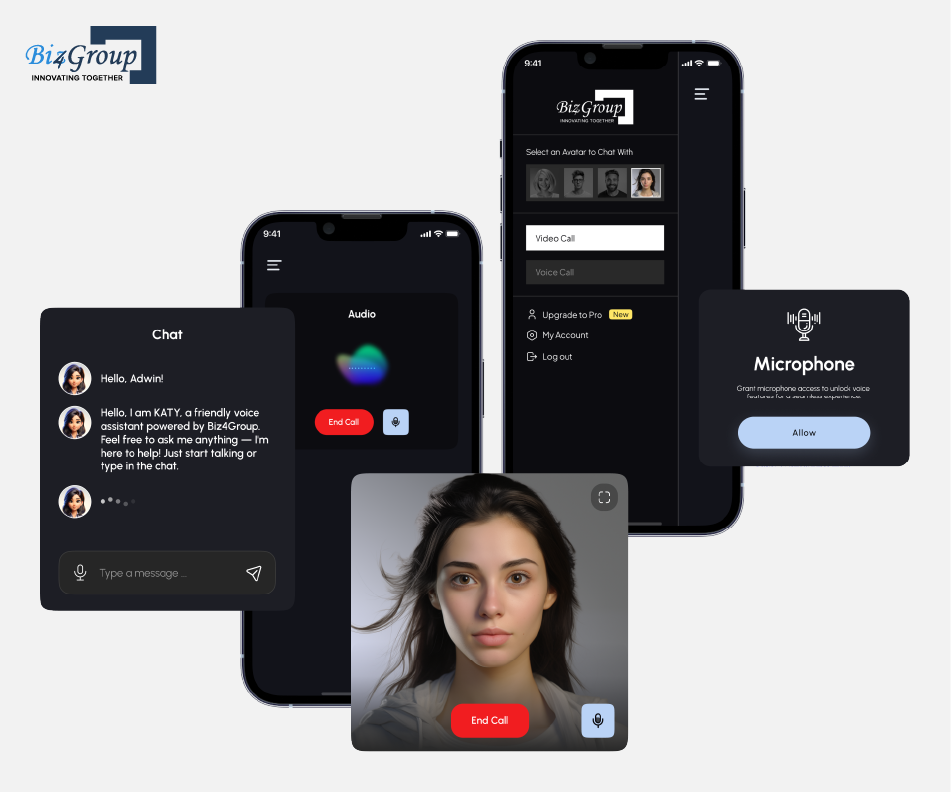
At Biz4Group, we don’t just talk about cost optimization, we deliver it.
One of our proud portfolio highlights is AI Wizard, an avatar-based AI companion designed to serve as a forever empathetic friend through voice and video calls. The project reflects how smart use of integrations, frameworks, and cost-optimization strategies can lead to groundbreaking yet affordable AI solutions.
Project Overview
AI Wizard was envisioned as a personalized avatar-driven AI companion, always ready to assist users during moments of boredom, loneliness, or curiosity. Our team strategically leveraged D-ID for realistic avatar rendering and integrated ChatGPT and Whisper AI for seamless conversational experiences, all while ensuring development costs remained lean without compromising quality.
Key Features
- AI-Based Video Calls – Real-time avatars that mimic facial expressions and gestures for human-like interactions.
- AI-Based Voice Calls – Advanced speech recognition and ML models for smooth, real-time voice conversations.
- Avatar Customization – Users can select pre-designed avatars or even create custom avatars using their photos.
- Multi-Channel Communication – Chat integration along with connectivity to Reddit, Discord, and Facebook.
- End-to-End Encryption – Secure conversations across all modes.
- Cross-Platform Compatibility – A single solution working flawlessly on iOS, Android, and Web.
Challenges We Faced
User Experience Challenges
- Personalization: Designing a truly empathetic and adaptive AI required algorithms capable of learning evolving user behaviors.
- User Engagement: Keeping users engaged meant continuously updating and rolling out new features.
Solutions: We implemented behavioral data analysis to learn from user interactions and incorporated incremental feature rollouts, ensuring AI Wizard stays engaging and adaptive without inflating costs.
Development & Maintenance Challenges
- Continuous Learning: Retraining AI models can be computationally expensive.
- Cross-Platform Compatibility: Achieving consistent performance across iOS, Android, and Web required rigorous optimization.
Solutions: We used incremental learning algorithms to reduce retraining costs and employed React Native for cross-platform development, significantly lowering build and maintenance expenses.
Cost Optimization in Action
AI Wizard is a perfect demonstration of how Biz4Group keeps development cost optimized without compromising innovation:
- Used D-ID integration instead of building avatars from scratch, trimming 20–25% of costs.
- Leveraged cross-platform frameworks to avoid triple development costs.
- Applied incremental AI learning to minimize heavy retraining expenses.
- Designed with phased rollouts, ensuring sustainable scaling and cost-efficiency.
The Result: A next-gen AI companion that combines empathy, interactivity, and scalability, built smartly with optimized costs, proving how Biz4Group transforms complex AI visions into budget-conscious realities.
The Biz4Group Edge
At the end of the day, the cost to develop an AI virtual assistant is only “expensive” if you don’t see a return on it.
Our job is to ensure you do.
That’s why businesses across industries partner with us not just to build, but to thrive.
Ready to optimize your costs and maximize your ROI? Let’s chat.
Because if your AI assistant isn’t working overtime for your business, then maybe it’s time your development partner did.
Final Thoughts
The real question is not simply how much an AI assistant costs. The bigger question is whether that investment creates measurable business value.
Whether you're researching the building cost of intelligent virtual assistant solutions or comparing companies that develop AI virtual assistants and their pricing in USA, the goal should be finding the right balance between cost, scalability, performance, and long-term ROI.
AI virtual assistants typically range from $10,000 to $150,000+, but pricing alone should never drive your decision. The right solution reduces operational costs, improves customer experiences, automates workflows, and creates sustainable growth opportunities.
If you're thinking, "I want to find a reliable company to build an AI virtual assistant and need a detailed cost estimate before hiring," focus on partners that provide transparent pricing, realistic roadmaps, and scalable architectures.
As a US-based software development company, Biz4Group helps businesses build AI assistants that are cost-efficient, scalable, and designed to deliver measurable business outcomes from day one.
Ready to estimate your AI assistant investment? Let's talk.
FAQs
1. Does the cost of an AI virtual assistant depend on the number of users?
Yes. The more users your assistant needs to handle, the higher the infrastructure and licensing requirements. Small-scale deployments can keep costs lean, while enterprise-grade rollouts may need larger budgets to ensure smooth performance.
2. Are there ongoing subscription or licensing fees with AI assistants?
Often, yes. Many AI solutions rely on third-party APIs, NLP engines, or cloud platforms, which come with monthly or annual fees. While these aren’t always huge, they add up and should be factored into your total cost.
3. How much should I budget annually for updates and improvements?
On average, businesses set aside 15–20% of the initial build cost each year for upgrades, bug fixes, and new features. Skipping this budget often leads to outdated assistants that can’t keep up with changing user needs.
4. Are AI assistants cheaper than hiring human staff?
In most cases, yes. While the upfront build cost can seem significant, AI assistants don’t take sick days, need training, or require salaries and benefits. Over time, they usually cost a fraction of what businesses spend on live agents.
5. What’s the ROI timeline for an AI virtual assistant?
It varies by industry, but many businesses see a return within the first 6–12 months. Cost savings from reduced labor, faster service, and improved conversions often accelerate payback.
